

For quarry operators, aggregate producers and procurement managers serving large infrastructure projects across Southeast Asia, few questions carry more commercial weight than whether a quarry can deliver consistent, specification-matched aggregate on schedule. Malaysia railway procurement and Vietnam construction material coordination frameworks both place strict contractual obligations on suppliers, where delivery delays or off-spec batches can trigger penalties, project downtime and lost tender opportunities. Many production teams face a confusing recurring problem: the plant, including its fixed screening machine, regularly reaches the designed hourly processing tonnage, yet the site still struggles to ship the required graded aggregate reliably. This disconnect between equipment throughput and dependable supply does not stem from one single failure point. It emerges from variation spread across five interconnected stages: raw material control, crushing stability, screening performance, finished quality management and final delivery coordination. To fix supply inconsistency, teams must audit each link rather than simply adding more crushing or screening capacity.

Raw Material Variation Undermines Stable Aggregate Output
Raw material consistency forms the foundation of predictable aggregate output, and it is often underestimated in production planning. Blasted rock from the quarry face naturally varies in hardness, fracture pattern, moisture and clay content, even within the same quarry zone. Some granite or limestone seams contain soft weathered layers, while others produce highly abrasive, blocky fragments. If blasting patterns change without adjusting downstream settings, the feed to the primary crusher fluctuates constantly. High moisture and sticky clay coat rock surfaces, clog deck openings on a fixed screening machine and reduce separation accuracy. Without stockpile segregation, pre-screening of fines and regular geological sampling, operators are forced to tune crusher gaps and screen parameters reactively, instead of maintaining a stable baseline. For railway-grade aggregate, particle shape and soundness requirements are far tighter than general road base material. A small shift in raw rock properties can create a batch that passes tonnage targets but fails lab testing, removing that material from the saleable pool even though the fixed screening machine worked according to its mechanical limits.
Crushing Circuit Stability Directly Affects Product Gradation
Crushing circuit stability is the second major factor separating nominal throughput from reliable supply. Quarries commonly measure success by the total tonnage leaving the primary jaw crusher, but this metric ignores gradation distribution. Secondary and tertiary crushers must maintain consistent closed-circuit settings to produce the target cubical fractions. When crusher liners wear unevenly, the output particle distribution drifts gradually. Operators may keep feeding rock to preserve tonnage numbers, while the proportion of oversize, flaky or elongated particles rises. Even a well-sized fixed screening machine cannot compensate for poorly shaped feed material, because screening only sorts particles by dimension; it cannot reshape rock. In many Southeast Asian supply coordination cases, quarries win supply contracts based on their published hourly capacity, but liner wear schedules, unplanned crusher stops and uneven recirculating loads create a sawtooth production curve. One shift may generate plenty of the required 10–20 mm aggregate, while the next shift produces mostly oversize rock that must loop back into crushing. The plant still averages its rated tonnage over a full week, but the procurement manager cannot receive a steady flow of the exact fraction needed for concrete or ballast works.
Screening Efficiency Decides Valid Product Split
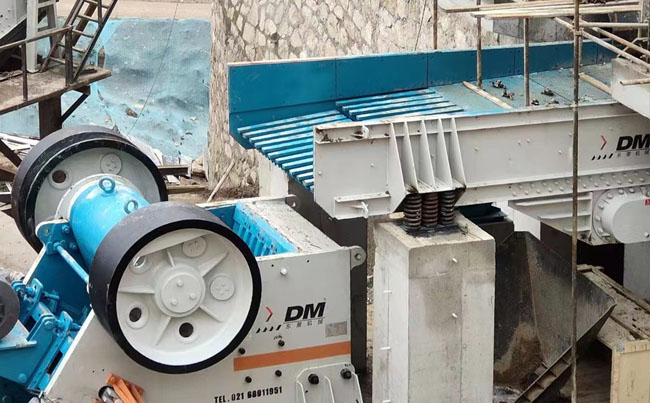
Screening operation, centered on the fixed screening machine, is where theoretical capacity and real product split diverge most visibly. A fixed screening machine is engineered for a defined feed rate, material moisture, deck angle, vibration stroke and mesh opening size. When any of these operating conditions drift, separation efficiency falls sharply. Common field issues include blocked apertures from wet fines, uneven feed distribution across screen decks, worn mesh panels that create oversized leakage and excessive recirculation loads that overwhelm the closed loop. Many operators set the fixed screening machine to maximize total throughput instead of prioritizing cut-point accuracy. This choice pushes more tons through the plant, but it allows cross-contamination between product bins. A bin labelled as approved railway ballast may contain excess fine material or mixed oversize, making the whole batch unsuitable for shipment. Screening performance also interacts directly with maintenance cycles. If screen inspection and mesh replacement are scheduled only after obvious breakdowns, subtle efficiency loss accumulates week by week. The control room dashboard still shows acceptable tonnage, but lab gradation reports start to fail specification checks. This is one of the most common hidden bottlenecks for suppliers working under coordinated national material supply systems in Vietnam and Malaysia.
Finished Quality Control Filters Qualified Aggregate for Delivery
Passing through a fixed screening machine does not automatically mean the aggregate meets project standards. Railway ballast, hydraulic engineering aggregate and high-strength concrete aggregate each carry unique test requirements: Los Angeles abrasion value, flakiness index, elongation, soundness, silt content and gradation envelope. A quarry can run steady tonnage through crushing and screening, yet produce batches that repeatedly fail these tests. Quality variation often comes from inconsistent raw rock blending, delayed liner maintenance, inadequate washing for clay-bound aggregate or poor segregation of finished stockpiles. When different production runs are stacked together without clear marking, clean approved material mixes with marginal or rejected stock. Procurement teams receiving mixed stockpiles face uncertainty about whether the aggregate can be used immediately, requiring extra sampling, rehandling or rejection. In tender environments where pre-qualification depends on consistent quality history, repeated marginal batches can disqualify a quarry from future large project supply opportunities, regardless of how high its hourly throughput is.
Logistics and Delivery Coordination Finalize the Supply Chain
The fifth stage, delivery coordination and logistics, completes the supply chain and can undo stable production upstream. Even if crushing, screening and quality control are perfectly balanced, inconsistent truck dispatch, limited stockpile space, poor loading sequencing and road access restrictions break delivery reliability. Large infrastructure buyers such as railway main contractors require predictable daily delivery volumes to keep batch plants and laying crews on schedule. If the quarry produces aggregate steadily but loading operations cannot match the agreed dispatch rhythm, stockpiles build or deplete too quickly. In regions where construction material supply is centrally coordinated, sudden delivery fluctuations force project planners to source emergency material from alternative suppliers. Many quarries overlook this link because they treat logistics as separate from production. In reality, the target output schedule should align crushing runs, fixed screening machine operation and stockpile turnover with confirmed trucking capacity and buyer consumption rates. Without this alignment, high equipment throughput only fills stockpiles intermittently rather than creating a continuous flow to the job site.
Practical Audit Framework to Stabilize Aggregate Supply
Bringing these five areas together creates a practical audit framework for any quarry trying to match its output to contractual aggregate specifications. First, map raw material sources and implement controlled blending and pre-screening to reduce feed variation. Second, establish fixed liner inspection intervals and closed-circuit crusher setpoints tied to gradation targets, not only tonnage. Third, tune the fixed screening machine for separation efficiency rather than maximum feed rate, with regular deck inspection, mesh rotation and moisture management. Fourth, build stockpile zoning, continuous sampling and lab feedback loops so quality results adjust production parameters before bad batches accumulate. Fifth, connect production planning with logistics schedules, matching daily target product volume to confirmed delivery slots.
Many quarry operators instinctively respond to supply complaints by planning a larger crusher or an additional fixed screening machine, assuming higher throughput will solve the consistency problem. This approach often wastes capital, because the real limitation is not total processing capacity but process stability across the full production chain. For buyers managing railway and major road projects in Malaysia, Vietnam and surrounding Southeast Asian markets, the most reliable suppliers are not always the ones with the highest headline tonnage. They are the operators who understand that steady, specification-compliant aggregate delivery depends on balanced control from quarry face to delivery gate. A fixed screening machine is a vital component of that system, but it cannot deliver consistent qualified aggregate in isolation. When raw rock, crushing, screening, quality testing and logistics operate in harmony, a quarry turns its mechanical throughput into dependable supply that satisfies the strict demands of large infrastructure procurement.
Latest Updates
Follow Us
Keeping crushing and screening equipment running worldwide.
Sign Up To Newsletter
Subscribe to get the latest parts news.
Post Comment