

In the sand and gravel aggregate industry, many stationary crushing production lines that have been in operation for years are stuck at the medium and fine crushing stage. Many quarry owners use outdated crushing equipment, and the produced aggregates have excessive flaky particles that fail to meet the high-standard aggregate procurement requirements of highway and water conservancy projects, so they can only be sold at low prices. Meanwhile, adjusting the discharge gap of equipment requires shutdown and gasket disassembly, and each adjustment takes several hours of downtime. Liners often suffer abnormal wear, leading to high consumption of spare parts. This problem is further amplified in mines processing high-hardness granite and basalt raw materials. Many factory owners intend to renovate production lines, but they do not know how to match crushing cavity type, production capacity and closed-loop screening. Blind equipment replacement will cause mismatched production lines and high circulating load. Heavy capital investment fails to achieve quality improvement goals. Cone crusher relies on laminated crushing principle and is specially designed for medium and fine crushing of hard rock. It serves as the core solution for technical renovation of existing stationary aggregate production lines and medium-fine crushing sections of new mine production lines. It can simultaneously solve core pain points such as uneven particle size, excessive flaky content and frequent shutdown maintenance of equipment. The following analysis will start from production line pain points, solutions, application scenarios, customer benefits, selection logic, maintenance key points and return on investment, providing implementable renovation ideas for aggregate manufacturers.

1. Core Pain Points of Traditional Hard Rock Medium and Fine Crushing Links
Most hidden risks of losses on hard rock aggregate production lines come from improperly selected medium and fine crushing equipment. The first pain point is substandard quality of finished aggregates. Poor extrusion crushing effect leads to excessive flaky particles in finished products. Large-scale infrastructure projects will directly reject such aggregates, which can only be sold as low-grade road base materials at discounted prices. The higher the production capacity, the greater the loss. The second pain point is cumbersome discharge adjustment. Old-style equipment must shut down and disassemble gaskets to adjust the discharge opening. One adjustment may take half a day or longer. When the required particle size of orders changes, the production line cannot respond quickly, resulting in lost opportunities for high-quality orders. The third pain point is out-of-control consumption of wear-resistant parts. When uncrushable metal debris enters the crushing cavity, liners and main shafts are easily damaged. Uneven and rapid wear of liners pushes up the cost of spare parts procurement and replacement labor. Frequent maintenance shutdowns reduce the effective operating time of the production line. The fourth pain point is unbalanced production line load. Uneven feeding and poor choke control cause unbalanced material distribution in the crushing cavity, resulting in large current fluctuations, increased energy consumption, and even "ring bounce" faults that force emergency shutdown and troubleshooting. The fifth pain point is unreasonable matching of closed-loop processes. In many production lines, screening and medium-fine crushing equipment are mismatched. Oversized materials circulate repeatedly, accelerating equipment wear, and the overall production capacity fails to reach the designed index. The superposition of these problems makes the aggregate plant seem to have sufficient production capacity, but in fact profits are continuously eroded.
2. Production Line Solution with Fixed Cone Crusher
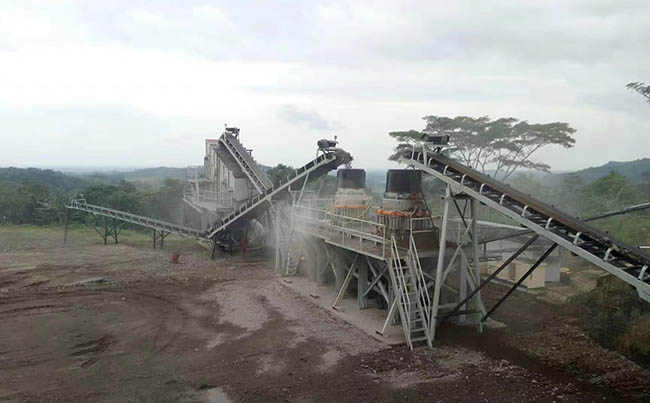
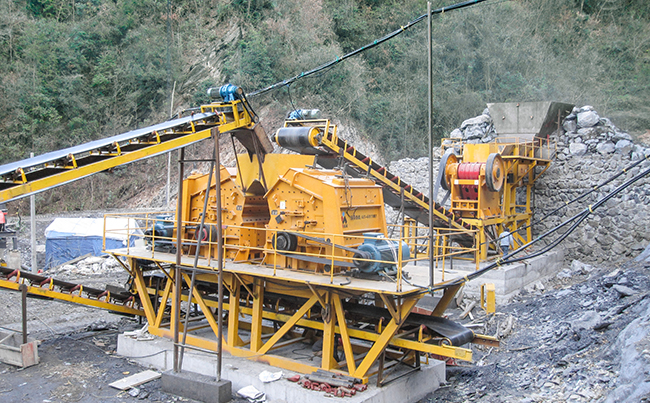
Cone crusher adopts laminated crushing cavity type. Materials are squeezed and ground against each other in the crushing cavity and broken along mineral cleavage planes. The finished aggregate has square particles and stable gradation, and the content of flaky particles can be controlled within high industry standards. The complete stationary production line process is as follows: raw materials go through primary crushing by fixed jaw crusher, then transported by belt into Cone crusher for medium and fine crushing operations. The crushed materials are sent to fixed screening machine for classification. Over-specification materials return to the cone crushing cavity through return belt to form a closed crushing and screening process.
The equipment is equipped with fully automatic hydraulic adjustment and overload protection system. When foreign objects such as iron blocks enter the cavity, the hydraulic system will automatically lift the mantle to discharge foreign matters and reset automatically after discharge to avoid damage to core components. Operators can remotely adjust the discharge gap in the central control room without shutting down and disassembling gaskets, quickly switching finished aggregate specifications to adapt to different engineering order requirements. For old production lines with feed segregation and non-choke operation, an intelligent feeding system can be matched to ensure materials enter the crushing cavity centrally, stably and in full volume, reduce uneven liner wear and lower power consumption per unit product. For raw materials of high-hardness granite and basalt, thick-walled wear-resistant liner configuration can be selected to extend the service life of vulnerable parts and reduce the frequency of spare parts replacement. Suitable for fixed-site and long-term mining large quarries and mine projects, the complete set of equipment can be matched with dust removal and noise reduction systems to meet mine environmental control requirements.
3. Typical Application Scenarios
The first type of scenario: new construction and technical renovation of hard rock aggregate production lines in large quarries. For hard rock processing such as granite and basalt, after primary crushing, Cone crusher is used for medium and fine crushing to stably produce high-grade aggregates supplied to expressways, railways and water conservancy projects. Such projects have long mining cycles, and the long-term operating cost of fixed-site production lines is far lower than mobile equipment, with outstanding advantages in continuous production.
The second type of scenario: tailings and mine waste rock resource utilization processing. Mining produces a large amount of waste rock and tailings. Processed by Cone crusher, they can be made into commercial aggregates, turning solid waste into saleable products, improving the comprehensive benefits of mines and meeting the requirements of solid waste resource utilization policies.
The third type of scenario: aggregate bases supporting large commercial concrete plants. Aggregate plants matched with commercial mixing stations have strict requirements on aggregate gradation and stability. Cone crusher continuously and stably produces aggregates that meet concrete specifications, ensuring stable raw materials for commercial mixing production and long-term supply to surrounding mixing stations.
4. Core Customer Benefits
The core benefit of adopting the Cone crusher solution is improved aggregate quality. High cubical aggregates can be directly supplied to high-value infrastructure projects and sold at significantly higher prices per ton, directly raising gross profit per ton. Secondly, hydraulic overload protection reduces the impact of hard objects on liners and main shafts, reducing abnormal loss of wear-resistant parts and cutting spare parts procurement costs. The function of remote hydraulic gap adjustment eliminates shutdown for discharge particle size adjustment, greatly increasing the effective production time of the production line and speeding up order response. After optimizing the closed-loop crushing and screening process, the power consumption per ton of aggregates decreases and production energy cost is controlled. Stable product quality facilitates signing long-term supply contracts with large engineering parties and avoids income risks brought by sand and stone market price fluctuations. Long-term stable operation of equipment reduces production losses caused by sudden shutdowns and ensures the annual output index of the project. In solid waste processing scenarios, solid waste disposal fees can also be reduced and additional sales revenue of aggregates can be generated.
5. Equipment Selection Logic
Before purchasing the Cone crusher, multi-dimensional evaluation needs to be completed. First, test the rock compressive strength and abrasion index of raw materials. Laminated crushing cavity type is preferred for hard rock, and standard cavity type can be selected for medium-hard stone. Second, calculate the target hourly output and maximum feed particle size, and reserve 10%~20% capacity margin to avoid accelerated wear caused by long-term full-load operation of equipment. Third, clarify finished aggregate specifications and flaky particle indicators to determine the adjustment range of discharge opening and cavity model. Fourth, evaluate the conveying capacity of belts and screening equipment of the original production line, confirm the load of return material system, and avoid overload of return material after renovation. Fifth, assess on-site foundation construction conditions, plant space and power supply capacity, and plan equipment foundation, dust removal and noise reduction supporting facilities. Sixth, check the after-sales service and spare parts supply capacity of manufacturers, and stock up core vulnerable parts such as liners and eccentric sleeves in advance to shorten downtime waiting time during faults.
6. Standardized Daily Operation and Preventive Maintenance
The stable operation of Cone crusher relies on standardized inspection and maintenance. Before startup, check lubrication system oil temperature, oil level and oil quality, confirm liner fastening status, clean residual stones in the crushing cavity, and check belts, couplings and hydraulic pipelines for leakage. Start the equipment under no-load condition, confirm no abnormal vibration and noise, and then start feeding. Maintain uniform and choke feeding throughout the whole process, and prevent large uncrushable debris from entering the crushing cavity. Regularly monitor liner wear, and plan replacement in advance before wear reaches the threshold to prevent liner damage from damaging the main machine. Record operating current, output, oil temperature and hydraulic pressure every day, establish equipment operation ledgers, predict component aging trends, and implement preventive maintenance to avoid sudden fault shutdown. Maintenance operations must implement power-off lockout safety specifications, and maintenance with power or pressure is prohibited. In rainy seasons, focus on checking return materials of belts to prevent fine mud from entering the crushing cavity and causing blockages, and regularly clean supporting screening equipment to ensure smooth circulation of closed-loop systems.
7. Return on Investment Analysis
For long-running stationary aggregate production lines, the return on investment of Cone crusher depends on raw material type, production capacity and product selling price. After technical renovation of hard rock aggregate plants, the upgrading of aggregate quality brings a premium of 15~30 yuan per ton. Combined with the reduction of spare parts consumption and capacity improvement brought by reduced downtime, most projects can recover equipment investment within 1~2 years. Compared with multiple old fine crushing equipment, a single high-performance Cone crusher can simplify the number of production line equipment, reduce supporting conveying and dust removal equipment, and cut civil engineering and infrastructure investment. In the long run, stable product quality brings continuous long-term orders and smooths the periodic price fluctuation risks in the sand and stone industry. When enterprises evaluate investment, they should not only compare the unit purchase price of equipment, but comprehensively evaluate the full life-cycle operating costs including wear-resistant parts service life, energy consumption, maintenance labor and shutdown losses.
Conclusion
Competition in the sand and gravel aggregate industry is gradually shifting from competing for production capacity to competing for quality, controlling costs and stabilizing supply. For long-term fixed-site projects such as hard rock mines, large quarries and commercial concrete aggregate bases, Cone crusher is the core equipment to solve the problems of excessive flaky aggregates, fluctuating particle size and frequent maintenance shutdowns in medium and fine crushing. Combined with reasonable closed-loop process design, accurate model selection and standardized operation and maintenance management, enterprises can stably produce high-grade aggregates, raise product selling prices, reduce spare parts, energy consumption and shutdown losses, and meet environmental protection and engineering material specifications. Whether building new aggregate production lines or renovating old production lines, it is necessary to comprehensively evaluate raw material characteristics, capacity requirements and matching degree of supporting equipment, and carry out solution planning from the perspective of full life-cycle cost, so as to ensure sustainable profit of aggregate projects and gain a firm foothold in the fierce sand and stone market competition.
Related Tags
Cone Crusher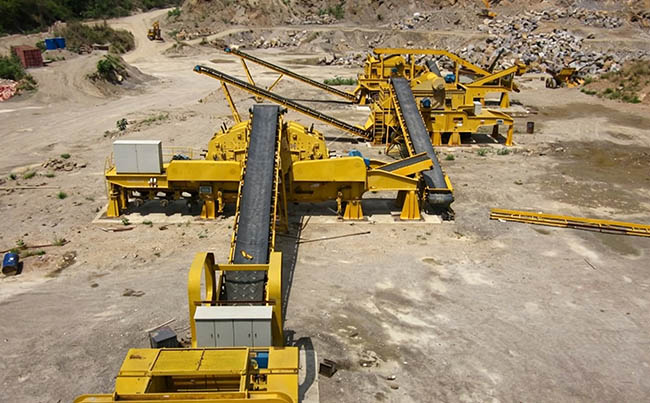
Latest Updates
Follow Us
Keeping crushing and screening equipment running worldwide.
Sign Up To Newsletter
Subscribe to get the latest parts news.
Post Comment