

Primary jaw crushers represent the first and most capital-intensive stage in mining, quarry and aggregate production flowsheets. Among all jaw crusher components, the toggle plate is often dismissed as a small, low-value part, yet it functions as both a critical force transmission element and a built-in overload safety device. Numerous mining operations have suffered extremely costly shutdowns originating from toggle plate failure: a fractured toggle plate can damage toggle seats, the main frame and even the eccentric shaft, turning a minor spare part swap into a week-long overhaul. For hard rock mines and large quarries running continuous production, proper selection and management of toggle plate jaw crusher systems directly determines primary crushing uptime and protects expensive host equipment.

Core Functions of the Jaw Crusher Toggle Plate
The toggle plate fulfills three indispensable roles in jaw crusher operation.
First, it transmits crushing force. The toggle plate connects the lower portion of the movable jaw to the adjustment mechanism on the rear frame, transferring reciprocating motion from the pitman and eccentric shaft into the crushing stroke of the jaw. Its geometry directly defines the jaw movement trajectory and crushing nip angle.
Second, it acts as a calibrated safety fuse. Under overload conditions caused by uncrushable objects such as steel scraps, drill bits or oversized boulders, the toggle plate is engineered to fracture intentionally. By breaking at a predetermined load, it absorbs excess impact energy and prevents permanent damage to the main frame, eccentric shaft, bearing jaw crusher assemblies and other high-value structural components.
Third, it enables discharge opening adjustment. By adding or removing shims behind the toggle seat, operators can fine-tune the closed side setting (CSS) to control product size. Each millimeter of shim adjustment typically compensates for 2 to 3 millimeters of cumulative wear on toggle plates and jaw plates.
Typical Toggle Plate Failures and Operational Impacts
The most frequent failure is premature fracture under normal working load. Low-quality cast toggle plates with internal sand holes, shrinkage cavities or improper heat treatment cannot withstand repeated cyclic compressive impact. Cracks initiate at stress concentration points and propagate rapidly, leading to sudden breakage during production. When a toggle plate fractures mid-operation, the movable jaw loses support and the entire crusher must be shut down immediately. In remote underground mines or isolated quarry sites, spare part delivery delays can extend downtime to multiple days.
Second, toggle seat wear and component misalignment. Poorly machined toggle plates with inaccurate dimensions create uneven contact with mating seats, causing localized high pressure and accelerated wear on both components. Worn toggle seats alter the crusher kinematic angle, reducing crushing efficiency and increasing power consumption. In severe cases, misaligned toggle plates slip out of position, causing further damage to the jaw stock.
Third, improper replacement practices create repeated failure cycles. Many maintenance teams replace only the broken toggle plate without inspecting toggle seat condition and adjustment mechanism integrity. A worn or damaged toggle seat will rapidly destroy a new plate, creating recurring breakdowns. Operators also sometimes substitute heavier, over-strength plates to reduce breakage frequency, which eliminates the overload safety function and risks catastrophic main frame damage.
Selection Criteria for Different Working Conditions
Choosing the correct toggle plate requires matching strength, material and dimensional precision to specific crusher models and operating environments.
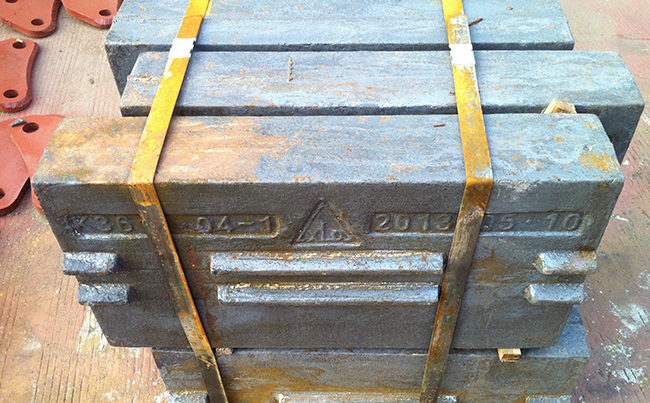
For standard quarry applications with limestone or medium-hard rock, high-quality gray cast iron toggle plates are appropriate. They exhibit controlled brittleness to fracture reliably under overload, offer adequate wear resistance for normal operation, and provide cost-effective performance for scheduled replacement.
For hard rock mines processing granite, iron ore or copper ore under high impact load and 24-hour continuous operation, alloy cast steel toggle plates are the superior choice. They deliver higher fatigue strength and longer service life under heavy cyclic loading, while still retaining the overload protection function through designed fracture grooves. This reduces routine replacement frequency without compromising equipment safety.
For large primary jaw crushers in large-scale mining projects, precision-machined toggle plates with strictly calibrated breaking force are required. The fracture load must be accurately matched to the crusher design overload limit, ensuring reliable protection without unnecessary breakage under normal load. It is essential to source jaw crusher parts from suppliers capable of delivering original-equipment equivalent dimensional accuracy to guarantee proper fit and function.
Installation & Preventive Maintenance Best Practices
Correct installation and systematic maintenance are equally as important as material quality for reliable toggle plate performance.
Before installation, thoroughly clean toggle seat contact surfaces and inspect for wear, cracks or deformation. If the toggle seat is worn beyond tolerance, repair or replace it before fitting the new toggle plate. Apply a thin, uniform layer of high-grade lubricating grease to contact surfaces to reduce friction wear during operation.
Ensure the toggle plate seats evenly and fully in both upper and lower toggle seats. Misalignment or partial contact causes concentrated stress and drastically reduces service life. Industry standards typically specify an alignment tolerance of ±0.2 mm. After installation, run the crusher under no-load condition first to verify smooth operation, then gradually increase feed load to full capacity.
Establish a tiered inspection routine. Daily, operators monitor for abnormal noise and symmetric jaw motion. Weekly, maintenance crews perform visual inspection of toggle ends and seats for scoring or galling. Monthly, lubrication is reapplied and tension spring settings verified. Quarterly, dimensional inspection measures toggle plate thickness and seat surface condition. Condition-based inspection is far more reliable than fixed-interval replacement.
Productivity & Economic Benefits of Reliable Toggle Plates
Investing in high-quality toggle plates and standardized maintenance delivers clear, measurable economic benefits for primary crushing operations.
First, it drastically reduces unplanned shutdowns. For a 500 tph primary jaw crushing line, a single unexpected 8-hour shutdown represents a loss of 4,000 tons of production, plus overtime labor costs for emergency repair. Reliable, properly specified toggle plates can reduce such unexpected failures by 70% or more, ensuring consistent feed for downstream crushing and screening processes.
Second, it protects major equipment investment. Repairing a jaw crusher main frame or eccentric shaft costs tens of thousands of dollars and requires weeks of downtime. The toggle plate acts as a low-cost insurance mechanism: by fracturing predictably under overload, it prevents expensive structural damage. The cost of replacing a set of toggle plates is negligible compared with major crusher overhaul expenses.
Third, it improves overall circuit efficiency. Properly fitted toggle plates maintain the crusher design motion trajectory, ensuring consistent crushing capacity and power efficiency. Worn or misaligned toggle plates can reduce crusher throughput by 10% to 15% and increase specific energy consumption per ton processed.
Conclusion
The toggle plate jaw crusher component may be small in physical size, but it plays an irreplaceable role in equipment safety and production continuity. For mining and quarry operators, treating the toggle plate as a critical safety component rather than a cheap consumable is fundamental to reliable primary crushing. By selecting the right material and strength grade for operating conditions, ensuring precision installation and implementing regular inspection of both plates and toggle seats, operations can significantly reduce unplanned downtime, protect their crusher investment and maintain stable, efficient primary crushing performance.
Latest Updates
Follow Us
Keeping crushing and screening equipment running worldwide.
Sign Up To Newsletter
Subscribe to get the latest parts news.
Post Comment