

As Vietnam coordinates material supply for key infrastructure projects and tightens quality requirements for construction aggregates, a common misunderstanding persists across both production and procurement teams: if a crushing and screening line runs at full throughput, it will deliver enough qualified aggregate to meet project schedules. Many site managers quote the rated tonnage of their fixed screening machine and primary crusher as their production capacity, assuming that every tonne passing through the plant translates into saleable, deliverable product. In reality, the gap between total processed tonnage and actual saleable aggregate can be surprisingly wide, and it is one of the most frequent causes of delivery delays, quality disputes and budget overruns on large construction sites.
A production line can record high hourly throughput while still failing to fulfil customer orders, because tonnage alone does not account for recirculating load, off-spec material, quality rejection and logistics constraints. For aggregate producers, recognising these layers of loss is essential to optimise existing plant capacity before investing in additional equipment. For procurement managers and project planners, understanding the difference between nameplate throughput and real deliverable volume is critical to selecting reliable suppliers and avoiding schedule disruptions. This article breaks down the four distinct layers of production volume — total throughput, target gradation yield, qualified product and final deliverable tonnage — explains why each one is smaller than the last, and outlines practical steps to narrow the gaps without unnecessary capital expenditure.

Total Throughput Measures Plant Input, Not Finished Value
Total throughput, the figure most often quoted as plant capacity, describes the total volume of material fed into the crushing and screening circuit over a given period. It includes every tonne of raw blasted rock fed into the fixed jaw crusher, plus all recirculating material that returns from the screening stage for reprocessing. This number is easy to measure with belt scales or feed rate estimates, and it aligns closely with the rated throughput values printed on equipment datasheets. However, total throughput is a measure of plant input, not of saleable output.
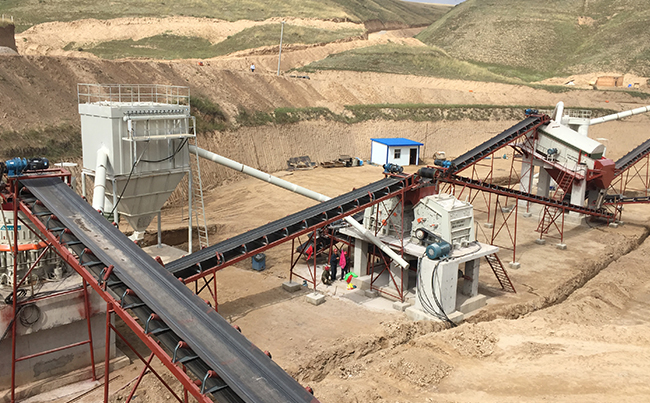
In a typical closed-circuit aggregate plant, material discharged from the primary crusher passes to a fixed screening machine, which separates the material into different size fractions. Oversize material that does not meet the top size requirement is sent back to the secondary crusher or back to the primary circuit for another pass. This recirculating load can make up 20 to 35 percent of the total feed to the screening machine, depending on the target product sizes and the reduction ratio of the crushers. That means roughly one quarter to one third of the tonnage recorded at the fixed screening machine is not new product, but material being reprocessed. When plant managers quote total throughput as production capacity, they are counting the same material multiple times as it circulates through the circuit.
Raw feed quality further inflates total throughput relative to saleable product. Blasted rock from the quarry face contains a certain share of waste material, heavily weathered rock, clay seams and soil that cannot be turned into high-grade construction aggregate. This material may pass through the fixed jaw crusher and enter the screening stage, but it is later removed as waste, low-grade fill or unusable fines. The total throughput number counts this waste material as processed volume, even though it never becomes saleable aggregate. For quarries working with variable reserve quality, waste dilution can reduce net usable feed by 10 to 20 percent before the material even reaches the secondary crushing and sizing stages.
Target Gradation Yield Depends on Feed and Circuit Setup
The next layer down is target gradation yield: the volume of material that falls within the required size fractions for the intended product mix. Most construction projects require multiple aggregate grades, such as 0–5 mm sand, 5–10 mm fine aggregate and 10–20 mm or 20–31.5 mm coarse aggregate. The fixed screening machine is responsible for separating crushed rock into these fractions, but its separation efficiency is never 100 percent. Some fine material stays trapped in the coarse fraction, and some coarse particles carry over into the finer fractions, especially at high feed rates or with wet, sticky material.
Several factors determine how much of the total throughput ends up as correctly sized product. First, feed gradation and material properties have a major effect. Hard, uniform rock with consistent blasting quality produces a more predictable size distribution after crushing, which makes it easier for the fixed screening machine to separate clean fractions. Soft, variable or clay-bearing feed produces a wider spread of sizes, more fines and more near-size particles that are difficult to screen accurately. Wet feed in particular can reduce screening efficiency by 25 to 40 percent, as moisture causes particles to stick together and blind the screen openings.
Second, screen setup and configuration directly influence yield. Deck angle, stroke amplitude, speed and screen media type all change how material travels across the screen and how well fine particles pass through the openings. A screen tuned for maximum throughput will usually have lower separation accuracy, while a screen tuned for precise grading will run at a lower tonnage but produce cleaner fractions. Many operations run their fixed screening machine at the highest possible feed rate to chase total tonnage, unaware that they are sacrificing separation accuracy and increasing the share of off-size material that must be recrushed or downgraded.
Third, the product mix itself determines yield. If a project requires a high share of a single narrow size fraction, the circuit will produce more oversize and undersize material that falls outside the target. If the product mix is broader and matches the natural gradation of the crushed rock, yield will be higher. Quarries that serve multiple customers with different specification requirements often find that their total throughput stays consistent, but their yield of any single product grade shifts significantly depending on current order mix.
Qualified Product Must Meet Full Quality Specifications
Even when material falls within the correct size range, it does not automatically count as saleable aggregate. Qualified product must meet all project specifications, including particle shape, surface cleanliness, clay content, crushing value, abrasion resistance and soundness. For key infrastructure projects such as highways, bridges and hydraulic engineering works, these quality requirements are strict, and every batch must pass testing before it can be accepted on site. Size compliance alone is never enough.
Particle shape is one of the most common reasons for rejection, especially for high-grade concrete and surface course applications. Angular, cubical particles produced by a fixed impact crusher generally meet shape requirements well, but if the crushing circuit is overloaded or the reduction ratio is incorrect, the share of flaky and elongated particles can rise above specification limits. Similarly, excess fines and clay coating on aggregate particles can fail cleanliness tests, even if the gradation is correct. Clay-bearing feed that passes through the fixed screening machine without adequate washing or scrubbing will produce aggregate that looks correctly sized but fails material acceptance testing.
Quality control processes also affect the volume of qualified output. Responsible producers run regular sieve analysis, shape tests and impurity checks, and they divert substandard material to lower-grade applications instead of shipping it. This means a share of correctly sized material is removed from the saleable product stream to protect quality and avoid on-site rejection. For projects with very tight specifications, the rejection rate for correctly sized material can reach 10 to 15 percent. Producers that skip intermediate quality checks often face higher rejection rates at the customer site, which reduces effective deliverable volume even more and damages commercial reputation.
Deliverable Volume Depends on Logistics and Site Capacity
Producing qualified aggregate is one thing; delivering it reliably to the project site is another. The final deliverable volume — the amount of qualified aggregate that actually arrives and is accepted at the customer's site — is almost always lower than the volume of qualified product produced at the quarry. Multiple logistics and storage constraints sit between the production stockpile and the project delivery point, and they are often overlooked when producers quote supply capacity.
On-site storage and loading capacity are the first constraints. A quarry may be able to produce a high daily volume of qualified aggregate, but if it has limited stockpile space, it cannot build up buffer inventory to cover peak demand, wet season shutdowns or short-term production interruptions. If loading equipment is already allocated to waste haulage and pit operations, truck turnaround times lengthen, and the number of deliveries per day drops. Small quarries in particular often have enough production capacity but insufficient loading and storage capacity to match large project delivery schedules.
Transport infrastructure and regulatory limits add further constraints. Provincial road weight limits, bridge load restrictions, seasonal road conditions and inter-provincial transport permit requirements all cap how much material can be moved each day. During monsoon seasons in Vietnam, unpaved access roads and slippery highway sections can reduce effective haulage capacity by 30 percent or more for weeks at a time. Project site conditions also matter: if the construction site has limited unloading space, restricted delivery hours or strict inspection procedures, truck queues form, and daily delivery volume falls below what the quarry can theoretically ship.
Practical Ways to Increase Saleable Aggregate Without New Equipment
The gap between total throughput and deliverable saleable aggregate is not fixed. Producers can narrow it substantially by optimising their existing circuit, without automatically buying additional crushers or screens. First, tune the fixed screening machine for better separation efficiency instead of maximum throughput. Adjusting deck angle, stroke settings and screen media type can often raise clean product yield by 10 to 15 percent with no capital cost. Reducing recirculating load to an optimal range also improves both throughput efficiency and product quality.
Second, improve feed preparation and blast design to deliver more consistent feed gradation and reduce waste dilution. Better blasting produces more uniform rock size, which improves crushing efficiency and screening accuracy. Removing clay and overburden before material enters the crushing circuit reduces contamination and lowers quality rejection rates. Third, strengthen in-plant quality control to catch off-spec material earlier, so that it can be reprocessed or diverted before it reaches finished stockpiles. This reduces customer site rejections and improves delivery reliability.
Fourth, optimise storage, loading and logistics operations to match delivery capacity with production capacity. Adding modest stockpile space, improving loading procedures and coordinating haulage schedules can often increase deliverable volume as much as adding extra processing equipment, at a much lower cost. For producers serving key construction projects, delivery reliability is often more valuable than slightly higher total throughput.
Conclusion
For aggregate producers, procurement managers and project teams across Vietnam's construction sector, it is critical to recognise that total plant throughput is not the same as saleable, deliverable aggregate. There are four distinct layers of volume to consider: total processed tonnage at the fixed screening machine and crushers, target gradation yield after size separation, qualified product that meets all quality specifications, and final deliverable volume that actually reaches the project site. Each layer is smaller than the one before, and the cumulative gap can be 40 percent or more between total throughput and net delivered qualified product.
Quoting nameplate throughput as supply capacity leads to overpromising, delivery delays and quality disputes. Planning procurement based on total tonnage without verifying actual qualified output and logistics capability creates unnecessary project risk. The most reliable producers focus on improving yield, quality consistency and delivery efficiency across their existing circuit, rather than simply chasing higher total throughput. The most effective procurement teams evaluate suppliers based on historical delivery performance and verified qualified output, not on equipment datasheet numbers. By aligning expectations with real operational capability, both producers and project teams can build more reliable supply chains for key infrastructure works, reduce commercial friction and ensure that construction schedules stay on track.
Related Tags
Screening Machine
Latest Updates
Follow Us
Keeping crushing and screening equipment running worldwide.
Sign Up To Newsletter
Subscribe to get the latest parts news.
Post Comment