

As Malaysia advances railway material procurement for infrastructure lines and Vietnam strengthens cross-provincial construction material supply coordination for key projects, aggregate suppliers face growing pressure beyond simple tonnage targets. Large-scale transport and hydraulic engineering works require not only sufficient volume, but also stable, uniform aggregate specification across every delivery batch. Many quarry operators assume that as long as their fixed impact crusher reaches the target hourly throughput, they can reliably supply qualified material for flagship projects. In practice, however, production lines with stable rated throughput often struggle to maintain consistent specification, leading to batch rejection, delivery delays and damaged commercial reputations. Consistent supply of qualified aggregate depends on far more than the nominal capacity of a single crushing machine. It relies on stable performance across five interconnected links: raw material input, crushing circuit operation, screening accuracy, finished product quality control and end-to-end delivery logistics.

For quarry owners, aggregate producers and procurement managers, understanding these five links is critical for both sides of the supply relationship. For suppliers, it helps identify hidden causes of inconsistent quality and unlock more reliable output from existing equipment without unnecessary capital expenditure. For procurement teams working on railway and key construction projects, it helps evaluate supplier capability beyond simple tonnage claims, reducing the risk of quality failures and schedule disruptions. This article breaks down each of the five operational links, explains how they affect supply consistency, and outlines practical steps to improve long-term supply reliability for large-scale infrastructure demand.
Raw Material Variability Erodes Supply Consistency
Every fixed impact crusher is designed and calibrated to perform best under a defined set of feed conditions, including rock hardness, abrasiveness, feed size distribution, moisture content and clay level. When feed material stays within these design parameters, the crusher produces a predictable gradation and particle shape. When feed properties shift, however, the output changes even if all machine settings remain exactly the same. In most quarries, raw material is never perfectly uniform, and this natural variability is the single largest source of product inconsistency.
Rock hardness and abrasiveness vary across different benches of the same quarry reserve. Harder, denser rock requires more impact energy to break, which can result in coarser discharge and a higher share of flaky particles if the crusher gap and rotor speed are not adjusted accordingly. Soft, weathered rock, on the other hand, produces more fines and can overload downstream screening equipment. Over time, as the quarry moves from one bench to another, the feed properties gradually shift, and the crusher settings that worked well for one zone produce out-of-spec material in another. Many operations do not test feed properties regularly or adjust crusher parameters proactively, so quality drifts slowly until a customer rejection forces a correction.
Moisture and clay content create even more sudden and severe quality disruption. During monsoon seasons in both Malaysia and Vietnam, rain increases moisture levels and washes clay seams into the blasted feed. Wet, clay-bearing feed sticks together inside the fixed impact crusher chamber, reduces effective breakage and produces a wider, less predictable size distribution. Clay also coats aggregate particles, causing failures in cleanliness and soundness tests even when the particle size appears correct. Worse, wet clay quickly blinds screen media on downstream fixed screening machine units, reducing separation accuracy and allowing off-size material to pass into finished product stockpiles. For quarries without pre-washing or scalping systems, a single period of heavy rain can disrupt product consistency for weeks.
Feed size distribution is another variable that affects crusher performance. Blasting quality directly determines the mix of boulders, medium rock and fines arriving at the crusher. Poorly controlled blasting produces a high share of oversize boulders and a wide size range, which forces the fixed impact crusher to operate outside its optimal feed window. Oversize material can cause rotor overload, uneven wear on blow bars and inconsistent discharge gradation. Too many fines in the feed cushion the impact action, reduce reduction ratio and increase the share of uncrushed particles. Quarries that treat blasting as a separate mining function rather than part of the production process almost always suffer from higher product variability.
Crushing Equipment Condition and Parameter Drift
The fixed impact crusher sits at the centre of the sizing process, and its mechanical condition and operating parameters have a direct effect on product consistency. Many operators focus on hourly throughput and pay little attention to gradual wear and parameter drift, which erode quality consistency over time. A crusher that produces on-spec material with new blow bars can start producing out-of-spec material gradually as wear progresses, without any obvious drop in total tonnage.
Blow bar wear is the most obvious factor. As impact surfaces wear down, the impact energy transfer becomes less efficient, and the effective gap between the blow bar and the impact plate changes. This shifts the discharge gradation toward coarser sizes and increases the share of irregularly shaped particles. In the worst cases, uneven wear on the rotor causes vibration, which further degrades product uniformity and accelerates damage to other components. Many quarries change blow bars only after a noticeable throughput drop or a mechanical failure, by which time product quality has already drifted out of specification for weeks.
Crusher gap adjustment and rotor speed also play critical roles. Small changes in the gap setting can produce measurable shifts in product gradation. If shift operators adjust the gap differently from one shift to the next, or if the adjustment mechanism drifts over time, product specification will vary between batches even with identical feed material. Similarly, rotor speed determines the impact energy applied to the rock. Higher speeds produce finer material and more cubical shape, while lower speeds produce coarser material and more flaky particles. If drive belts slip, motor performance drops or speed settings are changed without proper evaluation, product quality will shift accordingly.
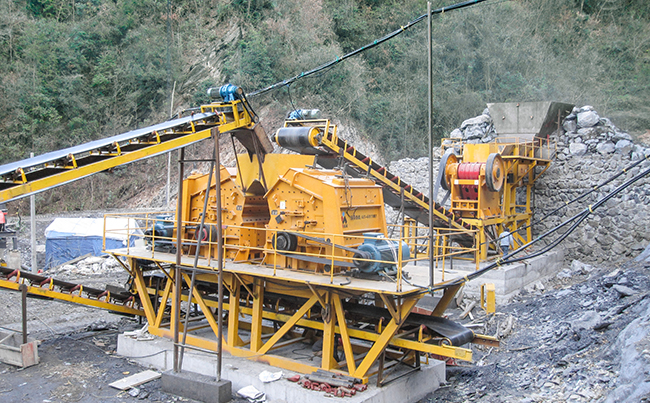
The balance between primary and secondary crushing stages also affects consistency. In a typical aggregate line, a fixed jaw crusher handles primary reduction and feeds material to the fixed impact crusher for secondary sizing. If the primary crusher discharge size varies widely, the secondary impact crusher receives an inconsistent feed size, which produces inconsistent output. Many operations focus their optimisation efforts on the secondary crusher and overlook the primary stage, not realising that stable feed size from the primary jaw is the foundation of consistent secondary crushing performance.
Screening Accuracy Determines Final Gradation Stability
Even when the fixed impact crusher produces a perfectly consistent discharge, the final product specification depends entirely on the performance of the fixed screening machine. Screening is the quality gate that separates on-size material from oversize and undersize fractions, and its accuracy directly determines whether the finished product meets specification. Screening efficiency is never 100 percent, and it can fluctuate significantly with changes in feed rate, material condition and equipment state.
Several common issues reduce screening consistency. First, screen media wear and damage. As wire mesh or polyurethane panels wear, opening sizes increase, allowing larger particles to pass into the fine product fractions. Tears or broken wires create localized defects that cause sudden spikes in oversize contamination. Second, screen blinding from wet or clay-bearing material reduces effective open area and changes separation behaviour. Blinding usually gets worse over the course of a shift, so product quality gradually degrades until the screen is cleaned. Third, incorrect deck angle, stroke amplitude or vibration speed can cause material to travel too fast or too slow across the screen surface, reducing separation accuracy. Fourth, overloading the screen with too much feed material pushes separation efficiency down sharply, as material bounces on the surface instead of passing through the openings.
In closed circuit configurations, where oversize material returns to the fixed impact crusher for reprocessing, screening performance also affects crushing consistency. If the screen allows too many on-size particles to return with the oversize, the recirculating load rises and the crusher chamber fills with already sized material. This reduces the crusher’s capacity for fresh feed and changes the breakage behaviour, which in turn changes the discharge gradation. Unstable recirculating load creates a feedback loop that amplifies variability across the entire circuit. Quarries that do not monitor recirculation ratio or screen efficiency often have wide swings in finished product gradation without understanding why.
Quality Compliance Beyond Size Gradation
Producing correctly sized aggregate is not the same as producing qualified aggregate. Infrastructure projects such as Malaysian railway lines and Vietnamese key construction works require compliance with a full set of quality parameters, including particle shape, crushing value, abrasion resistance, soundness, cleanliness and clay content. A batch of aggregate with perfect gradation can still be rejected if shape, strength or cleanliness fails testing. Consistent supply requires consistent quality verification, not just consistent tonnage.
Particle shape is one of the most frequently overlooked quality parameters for high-specification applications. Well shaped, cubical aggregate produced by a properly tuned fixed impact crusher improves concrete workability and asphalt performance. Flaky and elongated particles, by contrast, reduce strength and can cause specification failure. Shape quality can degrade gradually as blow bars wear, or suddenly if feed size or hardness changes. Many quarries only run gradation tests on a routine basis and check shape only when a customer complains, which means shape drift can go undetected for long periods.
Material cleanliness and impurity levels are another common source of rejection. Clay, silt and organic impurities can pass through the crushing and screening process and remain on aggregate surfaces. For projects with strict durability requirements, even low levels of clay contamination can cause batch failure. Without washing or scrubbing equipment, quarries operating in clay-rich geological areas struggle to maintain consistent cleanliness, especially in wet seasons. Similarly, weak or weathered rock particles in the feed can survive the crushing process and reduce the overall crushing value of the finished product.
The frequency and rigour of in-plant quality testing also determine consistency. Operations that test every shift and adjust process parameters quickly can correct small drifts before they become full batch failures. Operations that test only once per week, or only test at the point of customer delivery, will always have higher variability and higher rejection rates. For suppliers serving long-term infrastructure projects, investing in regular on-site testing is far cheaper than dealing with rejected deliveries and schedule claims.
Logistics Capacity Shapes Delivery Reliability
The final link in consistent supply is delivery. A quarry can produce perfectly consistent, high-quality aggregate every day, but if it cannot load and transport that aggregate reliably to the project site, the customer will experience the supply as inconsistent and unreliable. Delivery capacity and logistics performance are often treated as separate from production capability, but they directly determine the customer’s perception of supply consistency.
On-site storage capacity is the first logistics constraint. If finished product stockpiles are too small, the quarry cannot build buffer inventory to cover short production interruptions, maintenance shutdowns or periods of peak demand. When production is disrupted for even a day, deliveries drop immediately because there is no reserve to draw from. Larger, well segregated stockpiles allow a quarry to absorb short-term production variability and maintain steady delivery to customers.
Loading capacity and truck turnaround time are the second constraint. If there are not enough front-end loaders, or if loading procedures are slow and disorganised, trucks spend more time waiting than driving. This reduces the number of deliveries per day, even if production volume is sufficient. For projects with tight delivery windows, slow loading can cause missed schedules even when product quality is perfect.
Transport infrastructure and external conditions add another layer of variability. Long-distance supply for railway projects in Malaysia and cross-regional supply in Vietnam depend on public road conditions, weight restrictions, permit requirements and weather. During wet seasons, unpaved access roads and slippery highway sections reduce truck speeds and safe load weights, cutting daily delivery capacity. Quarries that do not account for these external logistics factors often overpromise delivery capacity and fall short during difficult seasons.
Practical Steps to Improve Supply Consistency
Improving supply consistency does not always require buying a larger fixed impact crusher or adding another processing line. Most quarries can achieve noticeable improvements by optimising their existing process across the five links described above. First, implement regular feed material testing and blast design optimisation to produce a more consistent feed size and reduce waste dilution. This creates a stable foundation for every downstream process.
Second, establish a proactive maintenance schedule for the crushing circuit. Replace blow bars and wear parts before performance degrades, standardise gap and speed settings across shifts, and monitor rotor vibration to detect uneven wear early. Third, optimise screening performance by selecting appropriate screen media, tuning deck angle and stroke, and implementing regular cleaning routines to prevent blinding. Monitor recirculation ratio to keep the closed circuit operating within a stable range.
Fourth, strengthen in-plant quality control with more frequent gradation, shape and cleanliness testing. Create clear adjustment protocols so that operators can correct small quality drifts immediately without waiting for management approval. Fifth, expand on-site storage capacity where possible, optimise loading procedures and align delivery scheduling with real transport capacity. This ensures that production gains translate directly into reliable delivery.
Conclusion
For quarry operators, aggregate producers and procurement managers across Malaysia and Vietnam, the most important takeaway is that a fixed impact crusher with adequate throughput capacity does not guarantee consistent supply of qualified aggregate. Supply consistency is a system outcome that depends on stable raw material input, well maintained and properly adjusted crushing equipment, accurate and reliable screening, rigorous in-plant quality control and dependable end-to-end delivery logistics. Weakness in any one of these five links will reduce overall supply reliability, no matter how capable the main crushing machine is.
Suppliers that want to compete for large infrastructure contracts should audit all five links, identify the largest sources of variability, and make targeted improvements before investing in larger or additional equipment. In most cases, better feed preparation, more proactive crusher maintenance, improved screening efficiency and more frequent quality testing will deliver bigger gains in consistency than replacing the crusher itself. Procurement teams should evaluate suppliers on their full process control capability and historical delivery consistency, not just on their stated nameplate capacity. As infrastructure demand continues to grow in both markets, the ability to supply the right aggregate consistently, batch after batch, will become an increasingly important competitive advantage.
Latest Updates
Follow Us
Keeping crushing and screening equipment running worldwide.
Sign Up To Newsletter
Subscribe to get the latest parts news.
Post Comment